Imagined What it could do
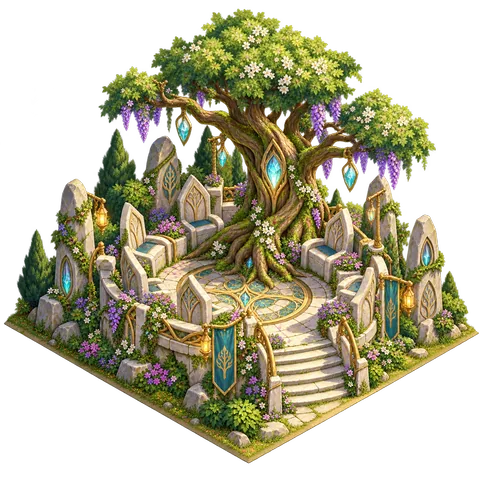
Imagine a bowl of carved seats in a forest clearing where a single voice on stage can be heard in the back row, with only birdsong and wind as the background music.
Real world Ancient sound engineering
The ancient Greek theater at Epidaurus, built in the 4th century BC and part of a UNESCO World Heritage Site, is famous for its acoustics; it is often said that people in the top rows can hear a coin dropped on the stage. Researchers believe the steep, curved rows of stone seats reflect speech toward the audience while scattering lower background noise.
Real world Nature's own concert hall
Near Denver, Colorado, Red Rocks Amphitheatre is built between two giant red sandstone rocks that reflect sound back to the audience. Concerts have been held there for about a century.
Designing an open-air theater today means choosing a site sheltered from traffic noise, shaping the slope so everyone can see and hear, and providing paths and seating for people with limited mobility.
Art In this artwork
This illustration shows a round arena of pale stone seats among trees, with carved arches.
Look closer
- Look at how the seats curve around the stage.
- Where would the audience enter?
Think about it
- Why might a curved shape help people hear?
- What performance would you put on in a forest theater?
- How could people with limited mobility reach the seats?
Key words
- Acoustics
- How sound behaves in a space.
- Amphitheater
- A round or oval open-air venue with rising seats.
- Reflect
- Bounce back.
Sources
The real-world facts on this page are based on these sources:
- UNESCO World Heritage Centre, "Sanctuary of Asklepios at Epidaurus"
- City and County of Denver, "Red Rocks Park and Amphitheater"