Real world Floating on magnets
Maglev is short for magnetic levitation. Powerful magnets lift a train a few centimeters above its guideway and push it forward. With no wheels touching a rail, there is less friction and noise.
The Shanghai Maglev has carried passengers to the city's airport since 2004, reaching about 430 km/h. In 2015 a Japanese test maglev reached 603 km/h, a world record for a train.
Real world Floating on air
In the 1950s the British engineer Christopher Cockerell developed the hovercraft, which floats on a cushion of air pushed down by fans. Hovercraft can cross water, mud and ice.
Possible future Hovering on the Moon and Mars
A hovercraft could not work on the Moon, because there is no air to push against. A hover car there would need a magnetic track, which would be costly to build. For now, wheels are the practical choice off Earth.
Art In this artwork
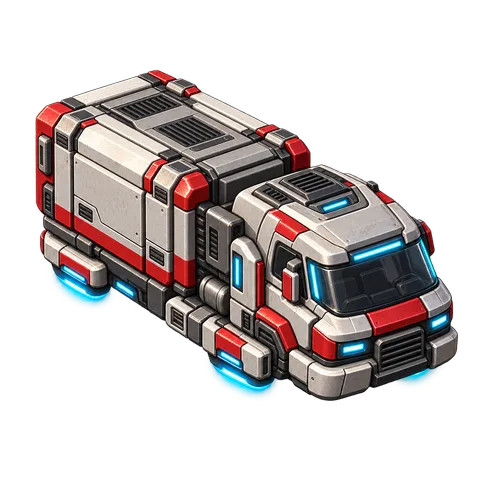
This illustration shows a sleek white and red car with glowing blue pads instead of wheels.
Look closer
- Find the glowing pads underneath.
- Compare it with the modern family car.
Think about it
- Why does a maglev train need a special track?
- Why couldn't a hovercraft work on the Moon?
- Would floating cars make streets safer or more dangerous?
Key words
- Levitation
- Floating in the air without support.
- Friction
- The force that slows things that rub together.
- Guideway
- The track a maglev train floats along.
Sources
The real-world facts on this page are based on these sources:
- Central Japan Railway Company, SCMaglev (603 km/h test run, 2015), and Shanghai Maglev Transportation, line opened 2004
- Encyclopaedia Britannica, "Hovercraft" (Christopher Cockerell, 1950s)