Real world Why towns needed a public clock
Before watches were cheap, most people could not own a clock. A clock high on a tower, often with bells, let a whole town know when to start work, open markets or go to church or school. Clock towers became symbols of civic pride.
Real world The problem of time zones
Until the late 1800s, each town set its clocks by the sun, so noon in one town was a few minutes different from noon in the next. That was fine until railways arrived: trains needed timetables that worked across hundreds of kilometers. On 18 November 1883, the railways of the United States and Canada switched to standard time zones. Countries later agreed world time zones based on Greenwich, in London.
Real world How a tower clock works
A traditional tower clock is driven by heavy weights that slowly fall, with a swinging pendulum controlling the speed. Gears turn the hands on each face. Big Ben's clock is still wound and adjusted by hand; its keepers fine-tune it by adding or removing small coins on the pendulum. Today most public clocks are set by radio or internet signals from atomic clocks.
Art In this artwork
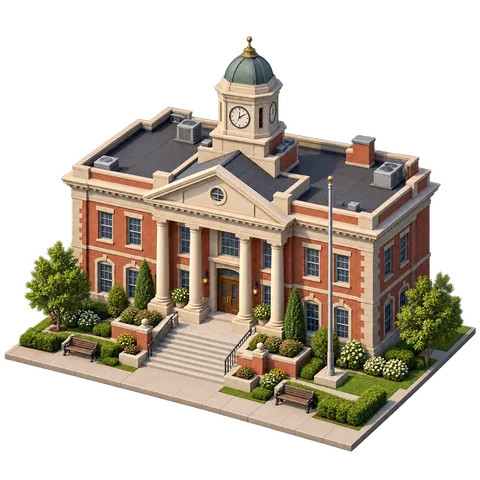
This illustration shows a brick clock tower. Its design is the artist's own.
Look closer
- Find the clock faces. How many directions can you see the time from?
- Is there a place for bells?
Think about it
- How would life be different if every town had its own time?
- Where do you see the time each day?
- Why do towns still build clock towers if everyone has a phone?
Key words
- Time zone
- A region that uses the same standard time.
- Pendulum
- A swinging weight that keeps a clock steady.
- Atomic clock
- An extremely accurate clock based on atoms.
Sources
The facts on this page are based on these sources:
- National Institute of Standards and Technology, history of time zones and standard time (1883)
- UK Parliament, "The Elizabeth Tower" (Big Ben)