Imagined What it could do
Imagine a waterfall pouring down a tall stone tower, its energy captured to light lanterns all over the green city, day and night, while the stream below stays healthy for fish.
Real world How falling water makes electricity
Water falling from a height has energy. In a hydropower system, water is channeled through a pipe to a turbine, a wheel with blades. The rushing water spins the turbine, which turns a generator to make electricity. The more water and the bigger the drop, the more power.
Small "micro-hydro" systems can power a single home, farm or village from a stream. Because water usually flows all the time, they can make electricity day and night, unlike solar panels.
Real world Keeping rivers healthy
Large dams can flood valleys and block fish from swimming upstream. Small "run-of-the-river" systems take only part of the stream's flow and return it downstream, with less harm. Fish ladders and screens help fish get past. Engineers must leave enough water in the stream for wildlife, especially in dry seasons.
Art In this artwork
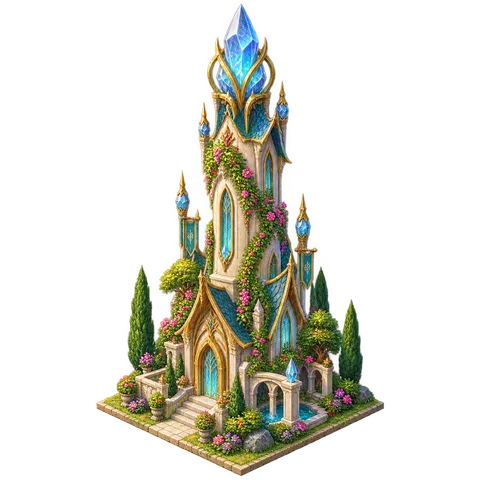
This illustration shows a tall tower of pale stone and blue glass, with water pouring down into a wide pool. Here we imagine its falling water making power.
Look closer
- Follow the water from the top of the tower to the pool.
- Where could a turbine be hidden?
Think about it
- What are the good and bad sides of getting energy from rivers?
- Why might water power work at night when solar does not?
- How can we share a river between people and fish?
Key words
- Turbine
- A wheel turned by flowing water, wind or steam.
- Generator
- A machine that turns motion into electricity.
- Run-of-the-river
- Hydropower without a big dam.
Use it in class
- What is solarpunk? (Explainer, grades 7-12)
Sources
The real-world facts on this page are based on these sources:
- US Department of Energy, Energy Saver, "Microhydropower Systems"
- Encyclopaedia Britannica, "Hydroelectric power"