Real world Choosing materials
Every material has strengths. Brick is durable and fire-resistant. Timber is light and renewable and stores carbon taken from the air by trees. Steel is very strong in tension and can span long distances. Concrete is cheap, strong in compression and can be poured into any shape, and with steel bars inside (reinforced concrete) it becomes strong in tension too.
Real world The carbon cost of building
Making cement, the glue in concrete, releases carbon dioxide, both from fuel burned in kilns and from the chemical reaction of heating limestone. A 2018 Chatham House report estimated that cement production accounts for around 8 percent of global carbon dioxide emissions; other estimates are lower, but all agree it is significant.
Engineers are cutting this by using less cement, replacing some of it with other materials, designing lighter structures and reusing old buildings.
Real world Building with wood again
New engineered woods, such as cross-laminated timber, glue layers of boards together at right angles to make large, strong panels. These can be used to build apartment and office buildings many stories high. Wood from well-managed forests can store carbon for the life of the building.
Art In this artwork
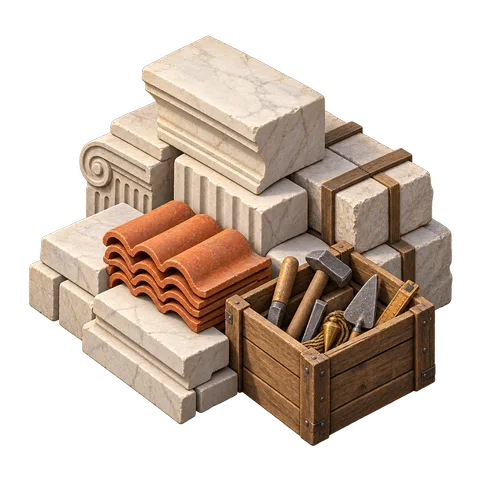
This illustration shows bricks, timber, cement bags and a traffic cone on a pallet, ready for a building site.
Look closer
- Find the bricks, timber and cement bags.
- Why is there a traffic cone?
Think about it
- Where do building materials come from, and how do they reach the site?
- Why might reusing an old building be better for the planet than building new?
- Would you live in a tall building made of wood? Why or why not?
Key words
- Reinforced concrete
- Concrete with steel bars inside.
- Embodied carbon
- The emissions from making and transporting materials.
- Cross-laminated timber
- Layers of wood glued crosswise into strong panels.
Sources
The facts on this page are based on these sources:
- Chatham House, "Making Concrete Change: Innovation in Low-carbon Cement and Concrete" (2018)
- Encyclopaedia Britannica, "Concrete", "Steel" and "Building construction"
- US Forest Service, Forest Products Laboratory, research on cross-laminated timber