Real world Why cranes are needed
Modern buildings are made of heavy parts: steel beams, bundles of reinforcing bars, concrete buckets, glass panels. Tower cranes lift these quickly and precisely to where they are needed, sometimes hundreds of meters up.
Real world How a tower crane works
- A concrete foundation or the building itself anchors the tall mast.
- The long working arm (the jib) carries a trolley that moves the hook in and out.
- The short arm carries heavy concrete counterweights to balance the load.
- The whole top slews (turns) on a ring.
- The operator sits in a cab at the top; a signaler on the ground guides them by radio.
Many tower cranes "climb" as the building rises: the crane lifts a new mast section, slides it into place, and raises itself onto it.
Real world Safety
Cranes are dangerous if overloaded or used in high wind. Each crane has a load chart showing how much it can lift at each distance from the mast, and computers warn the operator if a lift is too heavy. Workers are trained and certified, and areas under the load are kept clear.
Art In this artwork
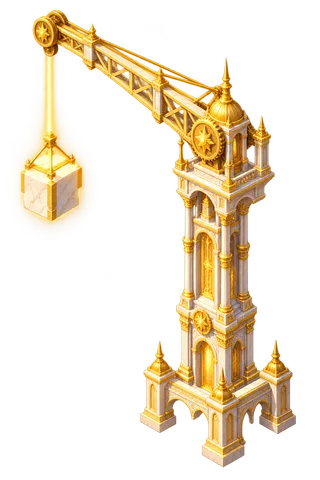
This illustration shows a yellow tower crane lifting a load. The soft glow is part of the original artwork.
Look closer
- Find the counterweight on the short arm.
- Follow the cable from the trolley to the hook.
Think about it
- Building sites can block sidewalks. How can a town keep people safe and moving while it builds?
- Why does a crane need a counterweight?
- How might a crane get to the top of a tall building, and back down?
Key words
- Jib
- The long horizontal arm of a crane.
- Counterweight
- A heavy weight that balances a load.
- Load chart
- A table of how much a crane can safely lift.
Sources
The facts on this page are based on these sources:
- US Occupational Safety and Health Administration, "Cranes and Derricks in Construction"
- Encyclopaedia Britannica, "Concrete", "Steel" and "Building construction"