History What it was
Most people in the Roman world lived and worked in the countryside. A villa rustica was a farmhouse at the center of a working farm, with rooms for the farm manager and workers, barns, animal pens and areas for pressing grapes and olives.
Farms ranged from small family plots to huge estates owned by wealthy landowners and worked largely by enslaved people.
History How it worked
The three most important crops of the Mediterranean world were grain (for bread), olives (for oil) and grapes (for wine). After harvest, grapes and olives were crushed in presses, and the juice or oil was stored in huge clay jars called dolia, often partly sunk into the ground to keep them cool.
Roman writers left practical guides to farming. Cato the Elder and, later, Columella explained how to choose land, plant vines, look after animals and organize workers.
History Feeding the city
A big city like Rome could not grow enough food for itself. Grain came from farms across Italy and from overseas, especially Egypt and North Africa, while wine and oil came from farms all around the Mediterranean.
History Places you can still see
Near Pompeii, at Boscoreale, you can visit Villa Regina, a small working farm buried by the eruption of Vesuvius in AD 79. Its courtyard still holds 18 large dolia, sunk into the ground to keep about 10,000 liters of wine cool, and a museum nearby shows how farms around the volcano worked.
Art In this artwork
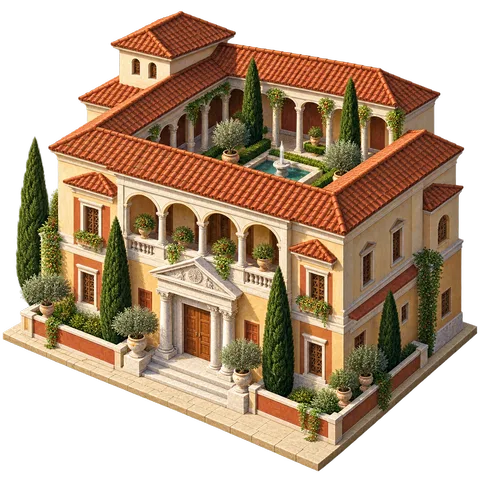
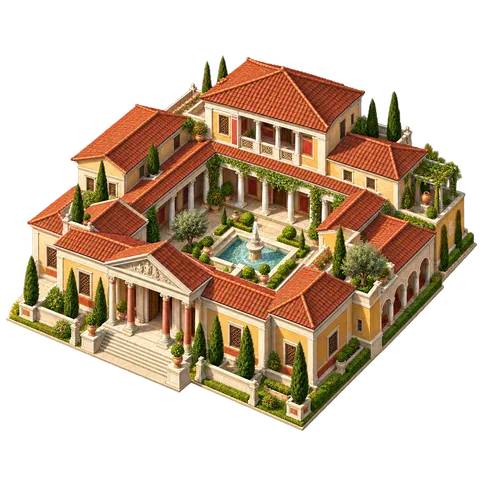
This small, cozy farmhouse is the artist's interpretation. Real villa rustica farms usually had several buildings and work yards.
Look closer
- Find the olive tree and storage jars.
- Notice the covered porch with columns.
Think about it
- Where does the food in your kitchen come from?
- Why might farmers store oil and wine underground?
- How did food get from farms to the city?
Key words
- Dolium
- A very large clay storage jar (plural dolia).
- Estate
- A large area of land owned by one person or family.
- Harvest
- Gathering ripe crops.
Sources
The history on this page is a short summary based on these sources:
- Cato the Elder, On Agriculture; Columella, On Agriculture
- Parco Archeologico di Pompei, "Villa Regina in Boscoreale"
- UNESCO World Heritage Centre, "Archaeological Areas of Pompei, Herculaneum and Torre Annunziata"