
The year of the Nile
Egypt has almost no rain, so life depended on the Nile. Egyptians divided the year into three seasons: the flood, when the river covered the fields; the growing season, when they planted wheat, barley and flax in the wet black soil; and the harvest. Farmers lifted water to their fields with a bucket on a pole called a shaduf.
Homes
Most homes were built of mud bricks, made from Nile mud mixed with straw and dried in the sun. Small windows high in the walls kept out the heat, and people often slept and worked on the flat roofs on hot nights.
Food and clothes
Bread and beer were everyday food, and workers were often paid in grain. People also ate onions, beans, lentils, fish and fruit such as dates and figs. Clothes were made of linen woven from flax: men wore a simple kilt and women a long dress, and many people went barefoot.
Work, school and play
Most people farmed, but Egypt also needed builders, potters, bakers, boatmen and scribes. Only a few boys, mostly from scribe families, went to school to learn hieroglyphs, copying texts onto pieces of pottery and limestone. Children played with balls, dolls and toy animals, and families played board games such as senet.
Questions for students
- Why did almost everything in Egypt depend on one river?
- Why might a flat roof be useful in a hot, dry country?
- Compare daily life in ancient Egypt and ancient Rome. What was the same, and what was different?
Questions students and teachers ask
What did ancient Egyptians eat?
Mostly bread and beer, with onions, beans, lentils, fish, dates and figs. Meat was a treat for most families.
Did children in ancient Egypt go to school?
Most did not. Children helped their families at home and in the fields. A few boys trained as scribes and learned to read and write hieroglyphs.
What were ancient Egyptian houses made of?
Most were made of mud bricks dried in the sun, with flat roofs and small windows to keep out the heat.
Building pages to use with this guide
 Ancient EgyptMud-brick houseA small house of sun-dried mud brick: the home of most Egyptian farmers and workers.
 Ancient EgyptVillage houseA house in a village like Deir el-Medina, home of the workers who dug and decorated the royal tombs in the Valley of the Kings.
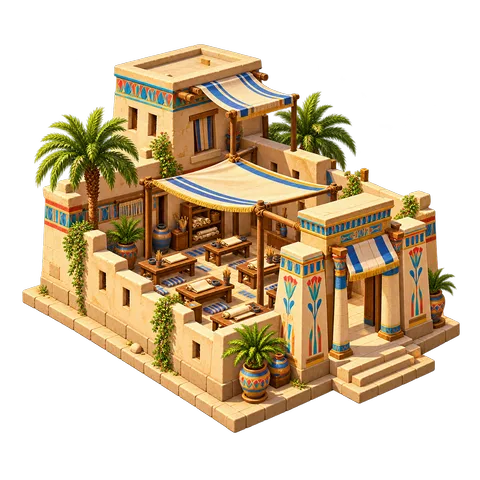 Ancient EgyptScribe schoolWhere boys, and a few girls, spent years learning to read and write so they could become scribes, the record keepers of Egypt.
 Ancient EgyptFamily houseA farming family's house with a palm tree, a little garden and stairs to the roof.
 Ancient EgyptMarketStalls of food, cloth and pottery where people swapped goods. Egyptians bartered: they traded goods for goods instead of paying with coins.
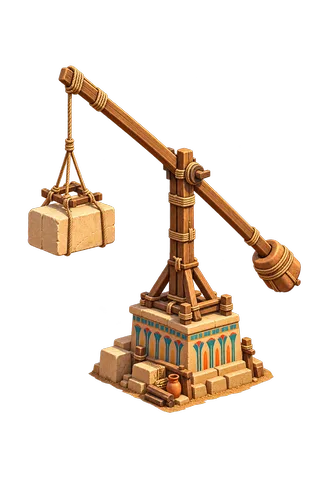 Ancient EgyptLifting leverA wooden lever with a counterweight, like the shaduf Egyptians used to lift water. Builders moved giant stones with levers, ramps and sledges.
Sources
The facts in this guide are based on these sources:
- Encyclopaedia Britannica, "Ancient Egypt"
- The British Museum, ancient Egypt collection and teaching resources
- Mark Lehner, "The Complete Pyramids" (1997)