History Boats without nails
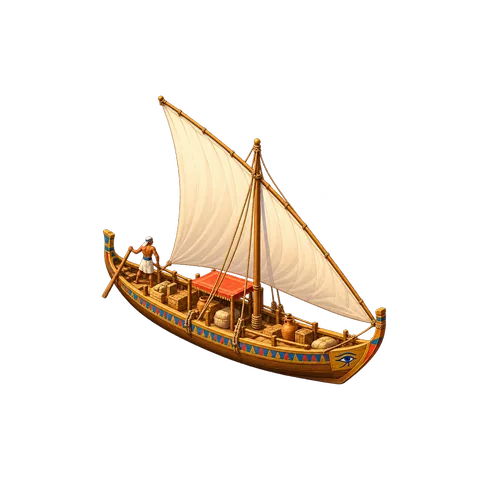
Egypt had few tall trees, so boatbuilders often worked with short planks of local acacia wood, fitting them together like a jigsaw with wooden pegs and tenons and tying them with rope. For the biggest ships they imported long beams of cedar from Byblos, in what is now Lebanon.
History Khufu's boat
In 1954 archaeologists opened a sealed pit beside the Great Pyramid and found a full-size cedar boat taken apart into 1,224 pieces. It took years to put it back together. About 43 meters long and 4,500 years old, it is one of the oldest boats in the world. In 2021 it was moved to the Grand Egyptian Museum near Giza.
History Ships for the Red Sea
Some ships sailed far beyond the Nile. Archaeologists think they were built by the river, carried across the desert in pieces and put back together on the Red Sea coast. In caves at a harbor called Mersa Gawasis, they found cedar ship timbers, coils of rope and wooden cargo boxes, two of them labeled "the wonders of Punt", left there about 3,800 years ago.
Art In this artwork
The illustration shows a shaded workshop where a wooden river boat is being built, with planks and tools around it.
Look closer
- Find the boat that is being built.
- What tools can you see?
Think about it
- Why might boats be so important in a country built along a river?
- Why would builders join planks with rope instead of nails?
- What is built or made near where you live?
Key words
- Shipwright
- A person who builds ships.
- Tenon
- A tongue of wood that fits into a slot to join two pieces.
- Hull
- The main body of a boat.
Sources
The history on this page is a short summary based on these sources:
- Mark Lehner, The Complete Pyramids (1997)
- Encyclopaedia Britannica, "Khufu"
- Kathryn Bard and Rodolfo Fattovich, excavations at the harbor of Mersa/Wadi Gawasis on the Red Sea (2001 to 2011)
- Ian Shaw (editor), The Oxford History of Ancient Egypt (2000)