History Boats of reeds
Papyrus grew thick in the marshes along the Nile. Tied in bundles, its stems made boats light enough for one person to carry. Fishermen cast nets from them, and paintings show wealthy Egyptians standing in papyrus boats to hunt birds in the reeds, as in the famous painting of Nebamun hunting in the marshes, in the British Museum.
History A plant of many uses
Papyrus was also turned into a writing material. Thin strips of the stem were laid side by side, a second layer was laid across them, and the sheet was pressed and dried. Our word "paper" comes from "papyrus".
History Across an ocean
How far could a reed boat go? In 1970 the Norwegian explorer Thor Heyerdahl and his crew sailed Ra II, a boat made of bundles of papyrus, across the Atlantic Ocean from Morocco to Barbados in 57 days. It was built by boatbuilders from Lake Titicaca in South America, where people still make boats of reeds.
Bible A basket among the reeds
In the Bible, when the pharaoh ordered that Hebrew baby boys be thrown into the Nile, the mother of Moses hid her son. "She got him a papyrus basket and coated it with tar and pitch. Then she placed the child in the basket and set it among the reeds along the bank of the Nile" (Exodus 2:3). The pharaoh's daughter found him and raised him as her own son.
Art In this artwork
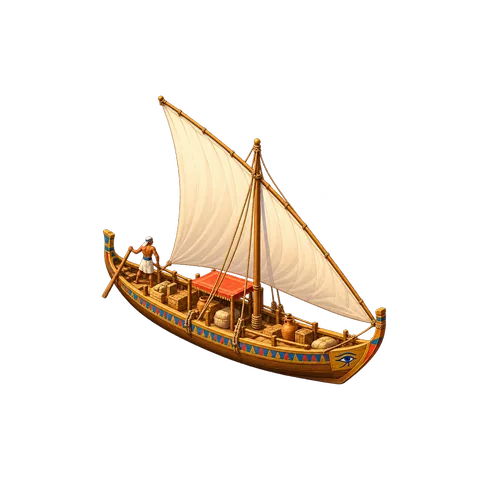
The illustration shows a reed boat with curled-up ends and a fisherman holding a net, very like the boats in Egyptian tomb paintings.
Look closer
- Find the curled-up ends of the boat.
- What is the fisherman holding?
Think about it
- Why might reeds float so well?
- What can people make from plants that grow near water?
- Where does the paper you use come from?
Key words
- Papyrus
- A tall marsh reed, and the writing material made from it.
- Marsh
- Low, wet land where reeds grow.
- Net
- A mesh of knotted string for catching fish.
Sources
The history on this page is a short summary based on these sources:
- Encyclopaedia Britannica, "Papyrus"
- British Museum, paintings from the tomb-chapel of Nebamun (garden pool, banquet and marsh hunt)
- Kon-Tiki Museum, Oslo, "Ra, 1969 - Ra II, 1970"
- Ian Shaw (editor), The Oxford History of Ancient Egypt (2000)
- The Bible, Exodus