History Bows for war and hunting
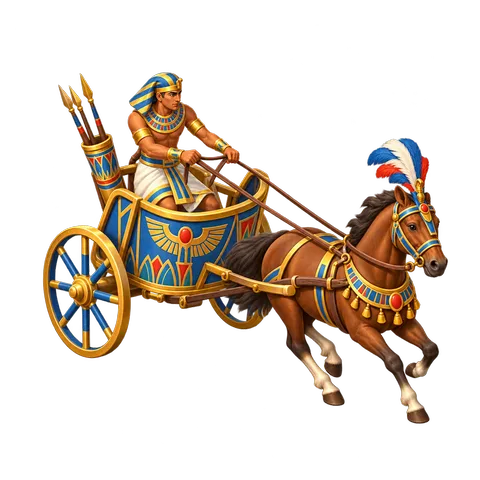
Archers were the backbone of Egypt's army, and hunting with a bow was a favorite sport of kings and nobles. Around 1600 BC, together with the horse and chariot, Egypt adopted the composite bow, made of layers of wood, horn and sinew glued together. It was harder to make but shot much farther than a simple wooden bow.
History A king's boast
King Amenhotep II, who ruled around 1420 BC, set up a stone slab near the Great Sphinx telling of his strength. It claims he shot arrows right through targets of copper as thick as a hand while driving his chariot. It is a royal boast rather than a measured record, but it shows how much Egyptians admired skill with the bow.
History An army of models
In the tomb of Mesehti, a governor at Asyut, archaeologists found two wooden companies of 40 soldiers each, made around 2000 BC: Egyptian spearmen with shields, and Nubian archers with bows and arrows. Nubian archers were so famous that Egyptians called Nubia Ta-Seti, "the land of the bow".
Art In this artwork
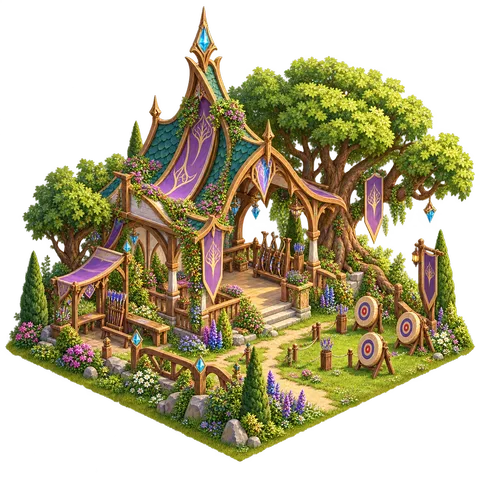
The illustration shows a sandy yard with round straw targets, a rack of bows and a shaded stand for watchers.
Look closer
- Count the targets.
- Find the rack of bows.
Think about it
- Why would an army need so many archers?
- Why might a king want people to believe he was very strong?
- Which sports today began as training for war or hunting?
Key words
- Composite bow
- A bow made of layers of wood, horn and sinew.
- Sinew
- Tough tissue that joins muscle to bone.
- Target
- A mark to aim at.
Sources
The history on this page is a short summary based on these sources:
- Stela of Amenhotep II near the Great Sphinx, about 1420 BC (his feats of archery and rowing)
- Griffith Institute, University of Oxford, Howard Carter's records of the tomb of Tutankhamun
- Egyptian Museum, Cairo, wooden model soldiers from the tomb of Mesehti, Asyut, about 2000 BC
- Encyclopaedia Britannica, "Nubia"
- Ian Shaw (editor), The Oxford History of Ancient Egypt (2000)