History Life on the water
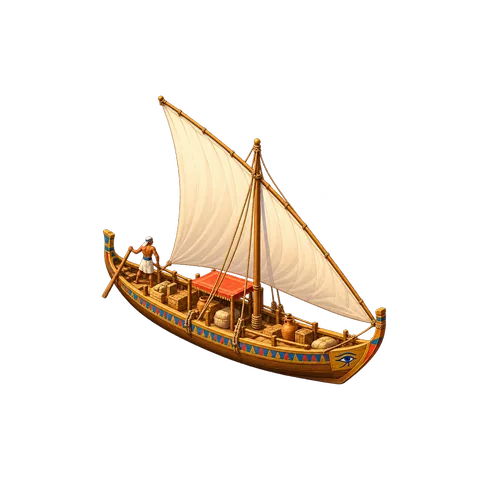
Boats carried almost everything in Egypt, from grain and cattle to giant blocks of stone, so the country needed many skilled rowers and sailors. Paintings and models show crews pulling long oars in time, with a steersman at the back holding a big steering oar.
History Showing off
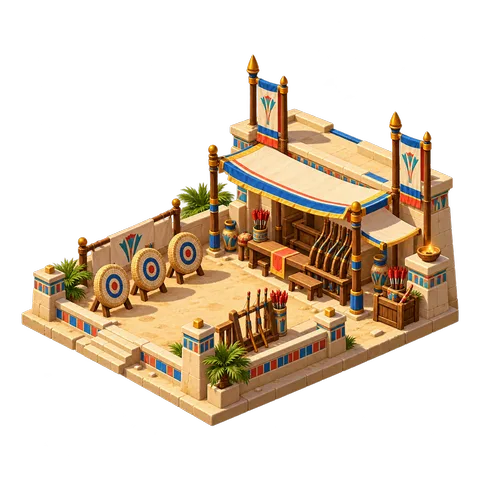
King Amenhotep II, who ruled around 1420 BC, set up a stone slab near the Great Sphinx boasting of his strength. It says he took the steering oar of his boat and kept rowing long after a crew of 200 men had grown tired. Like his claim to have shot arrows through copper targets, it was meant to show that the king was stronger than anyone.
History Rowing for the gods
At the yearly Opet festival in Thebes, the boat-shaped shrines of the god Amun, his wife Mut and their son Khonsu traveled on great river barges from Karnak to Luxor temple, towed by boats full of rowers while crowds celebrated on the banks. Carvings in the colonnade of Luxor temple show the whole journey.
Art In this artwork
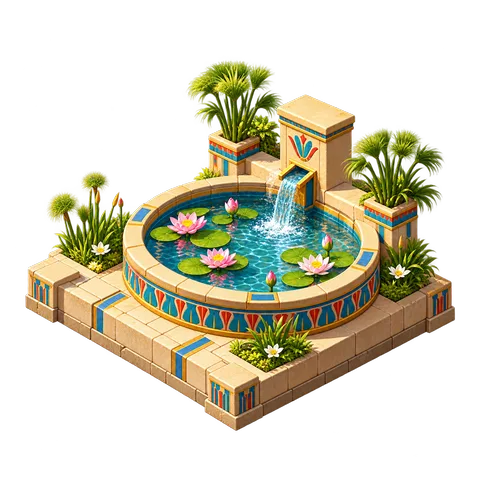
The illustration shows a long sandstone pool with a wooden dock and a small rowing boat. A pool like this is the artist's idea; Egyptians learned to row on the river itself.
Look closer
- Find the rowing boat and its oars.
- Where would you climb in?
Think about it
- Why must rowers pull their oars at the same time?
- Why would rowing matter so much on the Nile?
- What water sports do people enjoy today?
Key words
- Oar
- A long pole with a flat blade for rowing.
- Crew
- The people who work a boat together.
- Dock
- A platform where boats tie up.
Sources
The history on this page is a short summary based on these sources:
- Stela of Amenhotep II near the Great Sphinx, about 1420 BC (his feats of archery and rowing)
- The Metropolitan Museum of Art, models from the tomb of Meketre (granary, garden and boats), about 1980 BC
- Richard H. Wilkinson, The Complete Temples of Ancient Egypt (2000)
- Ian Shaw (editor), The Oxford History of Ancient Egypt (2000)