History What it was
Rome had no public school system. Families who could afford it paid a teacher to educate their children, and many children, especially from poor families, received little or no schooling. Wealthy families sometimes hired a tutor at home instead.
History Stages of learning
- From about age seven, a primary teacher taught reading, writing and counting.
- Older pupils studied Latin and Greek literature with a teacher called a grammaticus.
- Some young men went on to a rhetor to learn public speaking, needed for law and politics.
History How lessons worked
Classes were often held in a rented shop or a covered space open to the street, sometimes just behind a curtain. Pupils wrote on wooden tablets coated with wax, using a pointed stylus; the flat end could smooth the wax to start again. Ink and papyrus were used for more permanent writing. Counting might be done on fingers, with pebbles or on a counting board.
In the 1st century AD, the teacher Quintilian wrote a long book on education. He argued that teachers should be patient, that pupils learn better when encouraged than when punished, and that learning should start early.
History Writing that survives
At Vindolanda, a Roman fort near Hadrian's Wall in Britain, archaeologists have found hundreds of thin wooden tablets written in ink. Two of them have lines from Virgil's famous poem, the Aeneid, copied out as writing practice, perhaps by children learning to write, just as pupils copy sentences today.
Art In this artwork
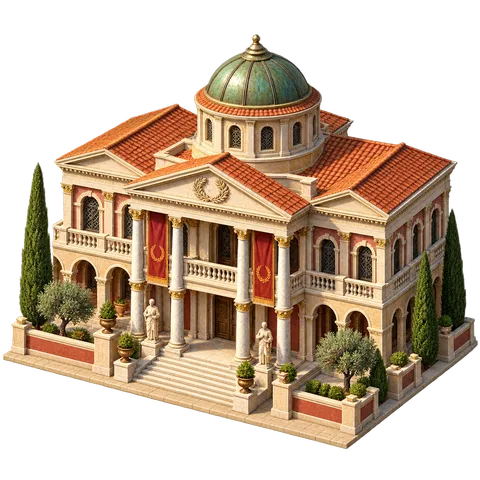
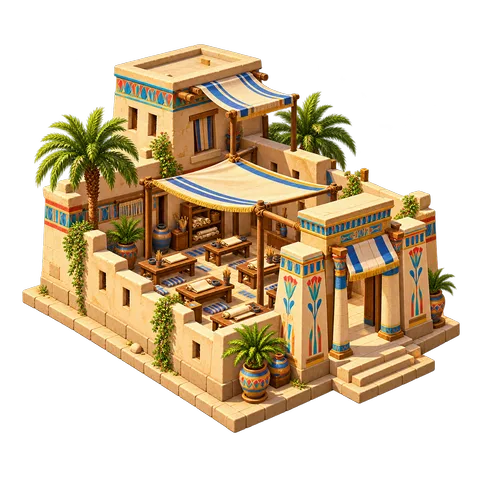
This open hall with shelves of scrolls is the artist's interpretation of a place of learning.
Look closer
- Find the shelves of scrolls.
- Notice the open arches. Could people passing by hear the lessons?
Think about it
- Who was left out of Roman education, and why does that matter?
- How is your school different from a Roman one?
- Do you agree with Quintilian that encouragement works better than punishment?
Key words
- Stylus
- A pointed tool for writing on wax.
- Grammaticus
- A teacher of literature and language.
- Rhetoric
- The art of persuasive speaking.
Sources
The history on this page is a short summary based on these sources:
- Encyclopaedia Britannica, "Education": the Roman world
- Quintilian, The Orator's Education, Book 1
- Vindolanda writing tablets 118 and 452 (lines of Virgil copied as writing practice), Roman Inscriptions of Britain