
Lesson goal
Students explain how four Roman engineering ideas worked, and why some Roman structures have lasted so long.
1. The arch
An arch carries weight around its curve and down into its supports, pushing the stones together instead of pulling them apart. Stone is very strong when squeezed, so arches let Romans span gaps for bridges, aqueducts and the outer walls of the Colosseum. The central wedge-shaped stone at the top is the keystone.
2. Roman concrete
Roman concrete was made with lime, water, volcanic ash called pozzolana, and chunks of stone or brick. It could be poured into molds to make walls, vaults and domes. The Pantheon's dome, about 43 meters across, is made of it and is still one of the largest unreinforced concrete domes in the world.
Scientists are still studying why it lasts. A 2023 study suggested that small lumps of lime in the mix may help cracks seal themselves when water seeps in.
3. Roads and surveying
Roman roads were built in layers, from coarse stone at the bottom to fitted paving stones on top, with a curved surface so rain drained off. Surveyors used tools such as the groma to lay out straight lines. The Via Appia, begun in 312 BC, can still be walked today.
4. Cranes and lifting
The architect Vitruvius described cranes using pulleys and a large treadwheel that workers walked inside. Pulleys trade distance for force, so a few people could lift heavy stone blocks.
Activity: test the arch
Give pairs a strip of card. First lay it flat across two books and add coins until it sags. Then curve it into an arch between the books, held in place at the ends, and add coins again. Which holds more, and why?
Questions students and teachers ask
Why do Roman buildings last so long?
Good design, durable materials and careful building. Arches keep stone in compression, and Roman concrete is very durable; researchers think lime lumps in the mix may help it heal small cracks.
What is Roman concrete made of?
Lime, water, volcanic ash (pozzolana) and chunks of rock or broken brick. Some mixes even set underwater, which helped in building harbors.
Did the Romans invent the arch?
No. Earlier peoples built arches, but the Romans used them on a huge scale in bridges, aqueducts and buildings, often together with concrete.
Building pages to use with this guide
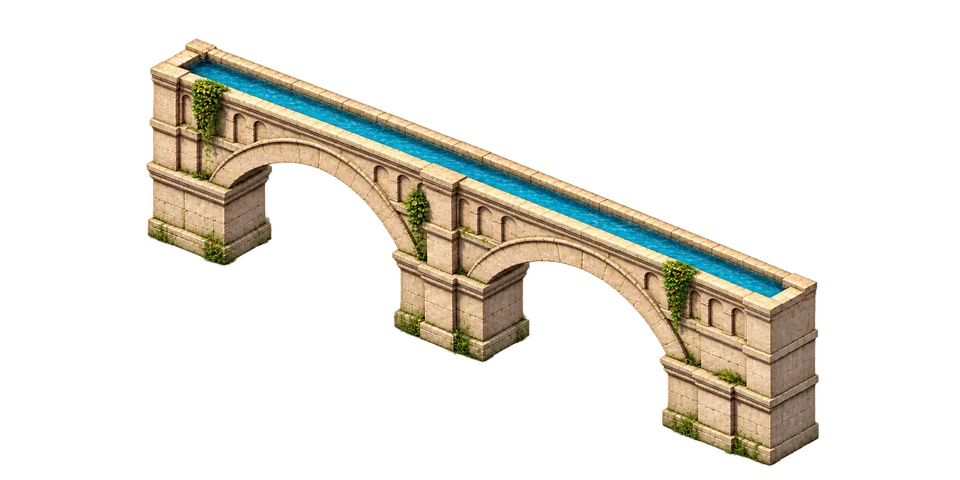 Ancient RomeAqueductA channel that carried fresh water from hills and springs many kilometers away into the city, using only gravity.
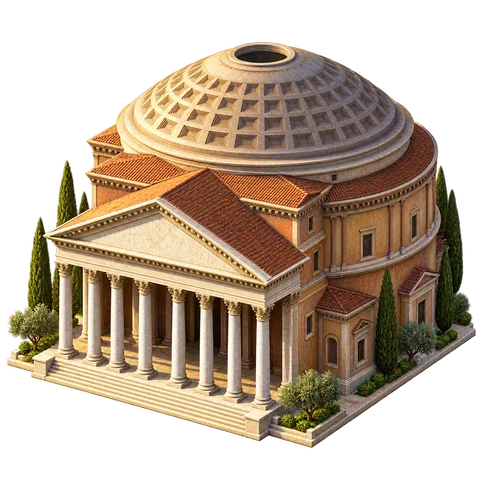 Ancient RomeThe PantheonA temple with a vast concrete dome and an open circle at the top, still standing and still in use in Rome.
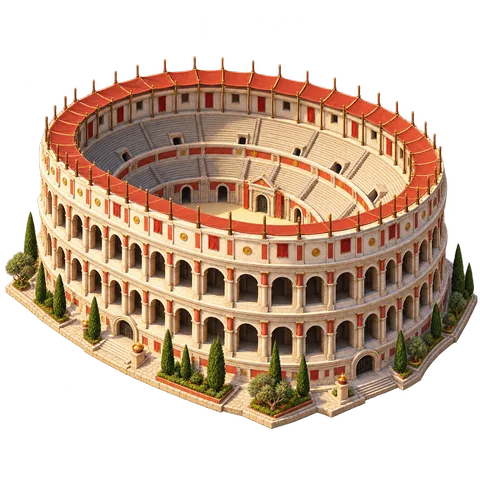 Ancient RomeAmphitheaterA giant oval arena where crowds watched animal hunts and gladiator contests.
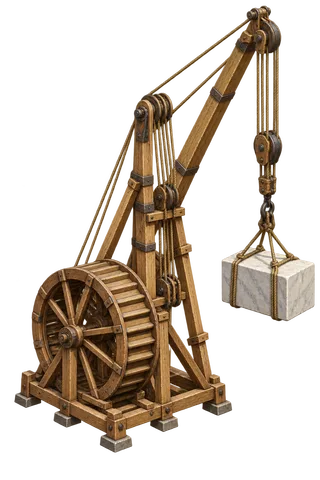 Ancient RomeTreadwheel craneA wooden crane with pulleys and a giant wheel that workers walked inside to lift heavy stone blocks.
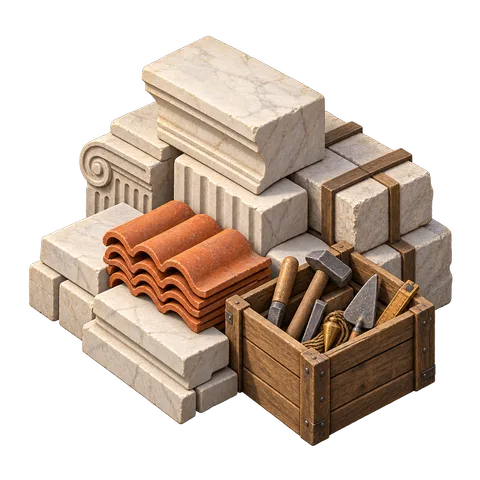 Ancient RomeBuilding materialsConcrete, brick, stone, marble and clay tiles: the materials that built Rome.
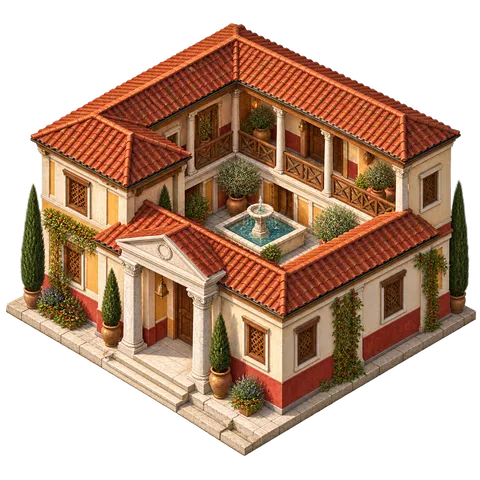 Ancient RomeRoadside innA place for travelers to eat, sleep and rest their animals along Rome's great roads.
Sources
The facts in this guide are based on these sources:
- Smarthistory, "The Pantheon, Rome"
- Seymour, Masic and others, "Hot mixing: Mechanistic insights into the durability of ancient Roman concrete", Science Advances (2023)
- Jackson and others, study of Roman marine concrete, American Mineralogist (2017)
- Vitruvius, On Architecture (1st century BC)
- Encyclopaedia Britannica, "Aqueduct"