Imagined What it could do
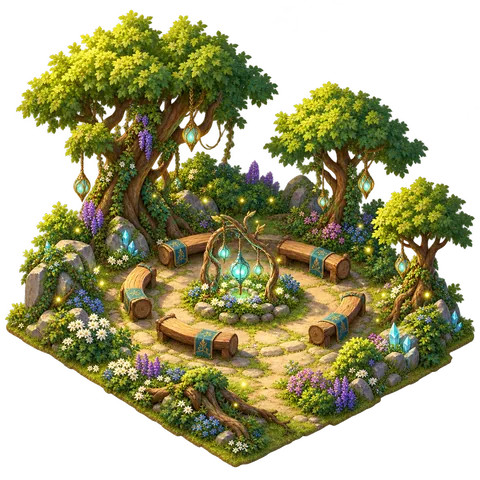
Imagine a stone terrace in the trees where every household sends someone to talk through how much wood to cut, where to let the forest rest, and how to settle disagreements fairly.
Real world The tragedy of the commons?
A "commons" is something shared by a group, such as grazing land, a fishing ground, a forest or groundwater. For a long time, many economists believed shared resources would always be overused, because each person benefits from taking more while the cost is shared by everyone.
Bible Caring for the garden
In the Bible, God gives people the job of looking after his world: "Then the LORD God took the man and placed him in the Garden of Eden to cultivate and keep it" (Genesis 2:15).
Real world How communities manage shared resources
The political scientist Elinor Ostrom studied communities around the world, from Swiss mountain pastures to Japanese forests and irrigation systems in Spain and Nepal, that had looked after shared resources well, sometimes for centuries. She found they shared certain features:
- Clear boundaries: everyone knows who can use the resource.
- Rules that fit local conditions, made by the people who use them.
- Monitoring, so everyone can see whether rules are followed.
- Fair, gradual penalties and simple ways to settle disputes.
In 2009 Ostrom became the first woman to win the Nobel Prize in Economic Sciences.
Art In this artwork
This illustration shows a pale stone terrace with carved seats and steps beneath a great tree.
Look closer
- Find the seats and the steps.
- Where would a speaker stand?
Think about it
- How would decisions be made fairly in a place like this?
- What "commons" do you share at school or at home?
- What rules would you make for sharing a forest?
Key words
- Commons
- Resources shared by a group.
- Monitoring
- Checking what is happening over time.
- Consensus
- An agreement reached by a whole group.
Use it in class
- How does local government work? (Lesson, grades 5-12)
- How to design a fantasy city: a worldbuilding guide (Guide, grades 6-12)
Sources
The real-world facts on this page are based on these sources:
- Elinor Ostrom, "Governing the Commons" (1990); Nobel Prize in Economic Sciences (2009)
- Garrett Hardin, "The Tragedy of the Commons", Science (1968)
- The Bible, Genesis