Real world Why recycle water?
Every kilogram launched into space costs a lot, and each person needs several liters of water a day for drinking, food and washing. Instead of bringing new water, space stations recycle it.
On the International Space Station, humidity from breath and sweat is collected from the air, and urine is distilled and filtered. In 2023 NASA announced that, with a new brine processor, the station could recover about 98 percent of the water crews bring aboard.
Real world How the system works
- Collect: water from sinks, condensed humidity and urine.
- Distil: urine is boiled at low pressure and the vapor is collected.
- Filter: water passes through filters and beds that remove impurities.
- Clean: a high-temperature reactor breaks down remaining contaminants.
- Check: sensors test the water before anyone drinks it.
Possible future A future fountain
In a Moon or Mars settlement, a fountain could be the visible end of this system: a reminder that every drop has been cleaned and reused many times. Water from local ice could top up the system to replace the small amount lost.
Art In this artwork
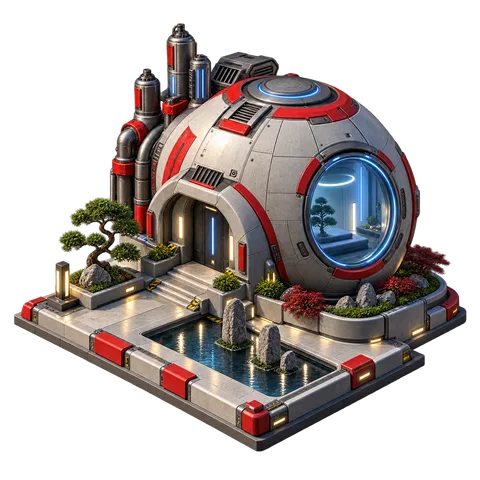
This illustration shows a glowing fountain in a plaza. Here we imagine it as the visible part of the settlement's water recycling.
Look closer
- Find the glowing column of water.
- Where could the cleaned water flow next?
Think about it
- Would you drink recycled water if you knew it was cleaner than tap water?
- How much water do you use in a day?
- What could cities on Earth learn from space water recycling?
Key words
- Closed loop
- A system that reuses its materials over and over.
- Distillation
- Boiling a liquid and collecting the vapor to purify it.
- Brine
- Very salty leftover water.
Use it in class
- Build a model Roman aqueduct: a hands-on STEM activity (Project, grades 4-8)
- How do cities get clean water? (Explainer, grades 4-12)
- How do astronauts live on the International Space Station? (Explainer, grades 3-12)
Sources
The real-world facts on this page are based on these sources:
- NASA, "Environmental Control and Life Support System" and the 2023 announcement of 98% water recovery on the International Space Station
- Encyclopaedia Britannica, "Life-support system"