Real world Why neighborhoods need them
The sociologist Ray Oldenburg described "third places": spaces outside home (the first place) and work or school (the second) where people meet, talk and build friendships. Community centers are one of the most important third places, because they are free or cheap and open to everyone.
Real world What happens there
- Classes for adults and after-school clubs for children.
- Lunches and activities for older people, who may otherwise be lonely.
- Meetings of residents' groups, charities and clubs.
- Celebrations such as birthdays, weddings and festivals.
- Advice on jobs, benefits or housing.
- Shelter, warmth or cooling during storms, heatwaves and emergencies.
Real world Designing for many uses
A community center needs a large hall that can be set up in different ways, smaller rooms, a kitchen, accessible toilets and storage. Movable walls, good acoustics and an entrance on the ground floor help it serve everyone.
Art In this artwork
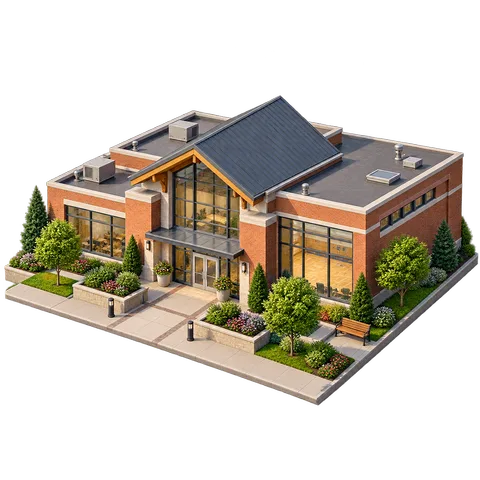
This illustration shows a timber and stone building with large windows and a welcoming entrance.
Look closer
- Notice the large windows. What activities might happen inside?
- Find the benches and paths outside.
Think about it
- What services or activities would you put in a community center?
- Where are the "third places" in your life?
- Why might a community center matter during an emergency?
Key words
- Third place
- A social space outside home and work.
- Volunteer
- Someone who helps without being paid.
- Multi-purpose
- Designed for many uses.
Use it in class
- Urban planning for students (Guide, grades 7-12)
- What makes a good place to live? Discussion questions (Lesson, grades 5-12)
Sources
The facts on this page are based on these sources:
- Ray Oldenburg, "The Great Good Place" (1989), on "third places"
- UN-Habitat, "World Cities Report"