History What it was
Vesta was the Roman goddess of the hearth, the fireplace at the center of every home. Her temple in the Roman Forum held a sacred fire that stood for the hearth of the whole city. Romans believed that if the fire went out, disaster could follow.
Unlike most Roman temples, which were rectangular, the Temple of Vesta was round. Some historians think the round shape recalls the round huts of Rome's earliest settlers.
History The Vestal Virgins
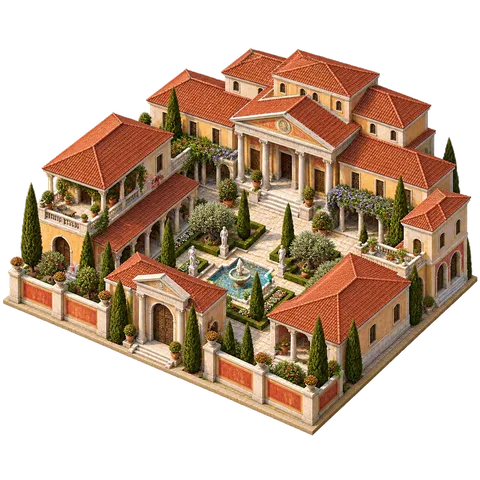
The fire was tended by six priestesses called the Vestal Virgins. They were chosen as young girls and served for 30 years: ten years learning, ten years performing the duties, and ten years teaching. They lived in a large house right next to the temple, the House of the Vestals, and had special honors and privileges, such as front-row seats at the games.
History What you can see today
The temple was damaged by fire and rebuilt several times. The section standing in the Roman Forum today was partly reconstructed in the 1930s. The courtyard of the House of the Vestals, with its long pools and statues of senior Vestals, can be seen next to it. A well-preserved round temple, also linked to Vesta, stands at Tivoli near Rome.
Art In this artwork
The flame shown in the doorway and the decoration are the artist's interpretation. The real sacred fire was kept inside, out of public view.
Look closer
- Look between the columns. What is burning inside?
- Notice the round shape.
Think about it
- Why might a shared flame matter to a whole city?
- What symbols do cities or countries use today to show they are united?
- Why would a temple be round instead of rectangular?
Key words
- Hearth
- A fireplace, the center of a home.
- Vestal
- A priestess of Vesta.
- Tholos
- A round building with columns.
Sources
The history on this page is a short summary based on these sources:
- Encyclopaedia Britannica, "Vesta"
- Smarthistory, "The Roman Forum (Forum Romanum)"
- Encyclopaedia Britannica, "Roman Forum"