Possible future How it would work
A Moon base would be made of several connected modules: sleeping quarters, a kitchen, labs, a gym and storage. If one module sprang a leak, hatches could seal it off, keeping the rest safe. Most of the base would be covered with meters of lunar soil to block radiation.
Real world Why the south pole?
The Moon turns slowly: a full day-and-night cycle lasts about a month, so most places have about two weeks of sunlight followed by two weeks of freezing darkness. Near the poles, some mountain peaks are lit almost all the time, which is good for solar power, while nearby craters stay permanently shadowed and may hold water ice. NASA's Artemis program is focusing on the south polar region for this reason.
Real world The challenges
- Radiation: the Moon has no magnetic field or thick atmosphere to block cosmic rays and solar storms.
- Temperature: surfaces in sunlight become hotter than boiling water, while shadows plunge far below freezing.
- Dust: lunar dust is sharp and clingy, scratching seals and irritating lungs.
- Distance: help is days away, so the base must be largely self-sufficient.
Art In this artwork
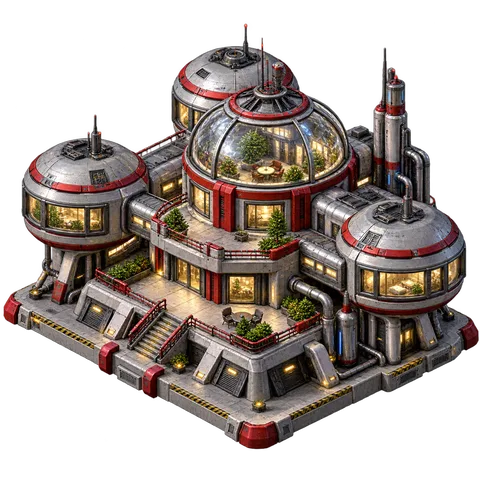
This illustration shows several domes joined together with glowing windows and plants. Its design is imagined.
Look closer
- Count the domes and find the links between them.
- Where is the main entrance?
Think about it
- Why might it be safer to build several small modules than one big one?
- How would you spend two weeks of darkness on the Moon?
- What would you miss most about Earth?
Key words
- Module
- One section of a larger structure.
- Pressurized
- Filled with air at a pressure people can breathe.
- Permanently shadowed crater
- A crater where sunlight never reaches the floor.
Use it in class
- Design a Mars colony: a student project (Project, grades 5-12)
Sources
The real-world facts on this page are based on these sources:
- NASA, Artemis program overview, including Gateway and plans for a lunar base camp
- NASA Human Research Program, hazards of human spaceflight (radiation, isolation, distance, gravity, hostile environments)
- NASA, LCROSS mission (2009) and studies of water ice in permanently shadowed lunar craters