Possible future How it would work
Robots would arrive before people. They would scoop up regolith, mix it with a binder, and print thick, curved walls layer by layer, like a giant 3D printer squeezing out icing. Domes and arches are strong shapes for holding back air pressure and carrying the weight of protective soil.
Real world Technology we already have
NASA ran a 3D-Printed Habitat Challenge from 2015 to 2019, inviting teams to design and print habitats using materials that could be found on Mars. On Earth, companies already 3D print concrete houses.
At NASA's Johnson Space Center in Houston, a 3D-printed habitat called Mars Dune Alpha, about 160 square meters in size, hosts long simulated Mars missions. In its first mission, four volunteers lived inside for 378 days, from June 2023 to July 2024.
Possible future Challenges to solve
Lunar and Martian soils are different from earth and sand, so engineers are testing ways to bind them: melting them with heat or microwaves (sintering), or mixing them with small amounts of binder brought from Earth. Printed walls may crack in extreme temperature swings, so they would need inner airtight liners and regular inspection.
Art In this artwork
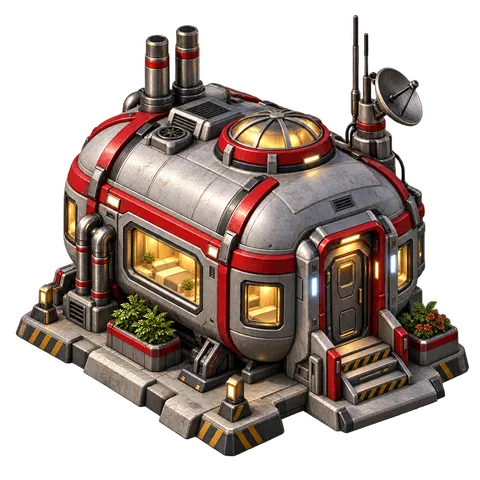
This illustration shows a low, armored dome with a heavy door. Here we imagine it printed by robots from local soil.
Look closer
- Notice how low and rounded the shelter is.
- Find the heavy door.
Think about it
- Why might it be better to build from local soil than bring materials from Earth?
- What would robots need to know to build a home without people?
- Would you volunteer to live in a simulated Mars base for a year?
Key words
- 3D printing
- Building an object layer by layer from a digital design.
- Sintering
- Heating powder until its grains fuse together.
- Analog mission
- A practice mission on Earth that copies conditions in space.
Use it in class
- How could humans live on Mars? (Explainer, grades 5-12)
Sources
The real-world facts on this page are based on these sources:
- NASA Centennial Challenges, "3D-Printed Habitat Challenge" (2015-2019)
- NASA, Crew Health and Performance Exploration Analog (CHAPEA) and the Mars Dune Alpha habitat
- European Space Agency, research on building with lunar regolith