History Market day
A town needed a market. On market day, usually once a week, farmers brought eggs, cheese, grain and animals into town, and townspeople sold cloth, shoes, pots and tools. In England a town needed a charter, a written grant from the king or a lord, to hold a market, and the lord collected fees from the traders.
Officials checked that weights and measures were honest, and sellers who cheated could be fined or shamed in public.
History Halls on arches
Many towns built market halls: an open space under arches on the ground floor, where traders set up stalls in the dry, and a room above for the town council or a guild. Thaxted Guildhall in England, from the 1400s, is built this way.
Big trading cities built grand cloth halls. The Cloth Hall in the main square of Kraków, Poland, began as a covered market in the 1200s.
History Fairs
A few times a year, bigger fairs drew merchants from far away with spices, silk, wine and fine cloth. The fairs of Champagne in France linked traders from Italy and northern Europe.
Art In this artwork
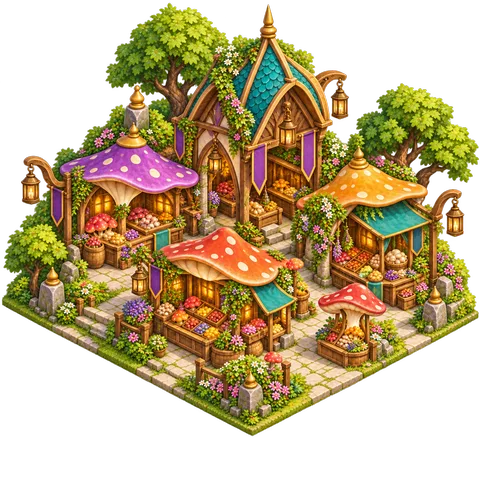
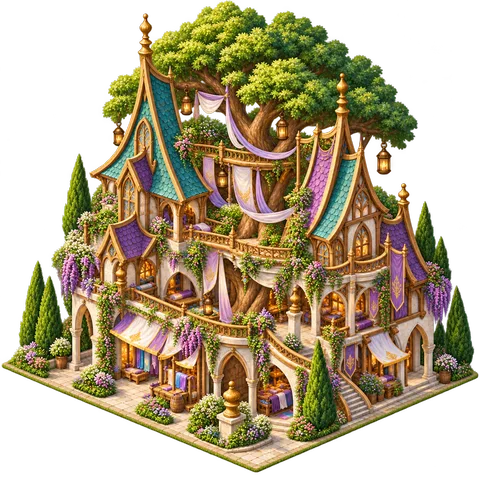
This hall with its stalls under stone arches is the artist's design, close to real market halls.
Look closer
- Find the stalls under the arches.
- What might be sold here?
Think about it
- Why would traders want to sell in a covered hall?
- Why was it important to check weights and measures?
- Where does your family buy food, and how often?
Key words
- Charter
- A written grant of rights, such as the right to hold a market.
- Fair
- A large market held a few times a year.
- Stall
- A table or booth for selling goods.
Use it in class
- Medieval market day: a lesson on guilds and trade (Lesson, grades 3-7)
Sources
The history on this page is a short summary based on these sources:
- Encyclopaedia Britannica, "Fair" and "Market"
- UNESCO World Heritage Centre, "Historic Centre of Kraków"