History How it was built
Most families lived in small houses made from local materials. The frame was timber, often made from pairs of curved beams called crucks. Between the posts, builders wove thin sticks into panels (wattle) and covered them with a sticky mix of clay, dung and straw (daub). The roof was thatched with straw or reeds.
A thatched roof kept the rain out well, but it could catch fire easily, so towns sometimes made rules against thatch.
History Inside
Many cottages had just one or two rooms. A fire burned on a hearth in the middle of the floor, for warmth and cooking, and smoke drifted up through the thatch. Furniture was simple: a table, benches, a chest and straw-filled mattresses. In some longhouses, the family lived at one end and the animals at the other in winter.
Outside was a yard and garden for vegetables like cabbage, onions, leeks and beans.
History What archaeologists found
At Wharram Percy in Yorkshire, archaeologists spent decades studying a village that was abandoned around 1500. They found that peasant houses were rebuilt every generation or so, because timber and clay did not last forever.
Art In this artwork
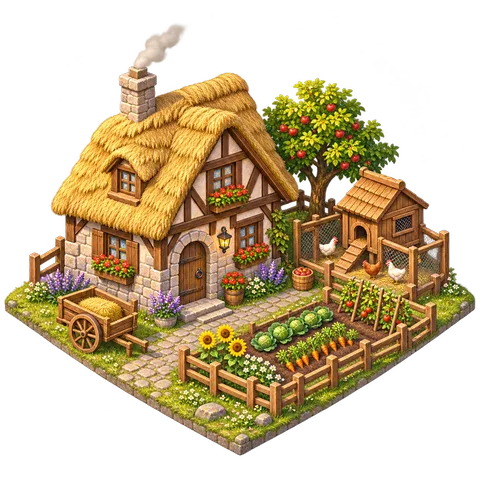
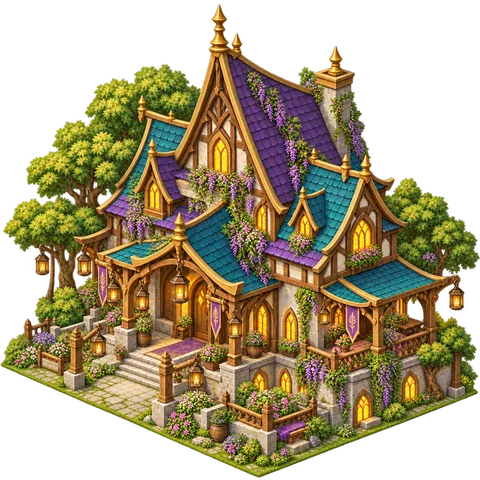
This cottage, with smoke curling from a chimney, is a cozy storybook version. Many real peasant homes had no chimney at all.
Look closer
- Find the vegetable patch.
- Where is the smoke coming from?
Think about it
- Why build with local materials like clay, sticks and straw?
- What would it be like to live in one room with a fire in the middle?
- Why might a house need rebuilding every generation?
Key words
- Wattle and daub
- Woven sticks covered in clay, used for walls.
- Thatch
- A roof made of straw or reeds.
- Hearth
- The floor of a fireplace, or a fire on the floor.
Use it in class
- What was daily life like in the Middle Ages? (Explainer, grades 3-8)
Sources
The history on this page is a short summary based on these sources:
- Encyclopaedia Britannica, "Half-timbering", "Wattle and daub" and "Thatching"
- English Heritage, "History of Wharram Percy Deserted Medieval Village"
- Encyclopaedia Britannica, "Manorialism" and "Serfdom"