History What it was
A castle was a private fortress and a home at the same time. A king or lord lived there with his family, servants and soldiers, and ran the land around it: collecting rents, holding courts and keeping order. Castles spread across Europe from about the 900s.
After the Normans conquered England in 1066, they built hundreds of quick castles called motte-and-baileys: a wooden tower on a tall earth mound (the motte) above a fenced yard (the bailey). Over time many were rebuilt in stone.
History How it worked
A stone castle was built in rings. In the middle stood the keep or great tower, the strongest place. Around it ran a high curtain wall with towers that let defenders shoot along the wall. Outside there was often a ditch or a moat full of water.
- Round towers were harder to knock down than square corners.
- Battlements on top had gaps to shoot through and solid parts to hide behind.
- Narrow slits in the walls let archers shoot out while staying protected.
- The gate was the weakest spot, so it got the strongest defenses.
History Places you can still see
Caernarfon Castle in Wales was begun in 1283 for King Edward I, with towers of different shapes and bands of colored stone. It is part of a World Heritage Site with other castles and town walls in the area. Windsor Castle in England, begun by William the Conqueror around 1070, is still a home of the royal family today.
Art In this artwork
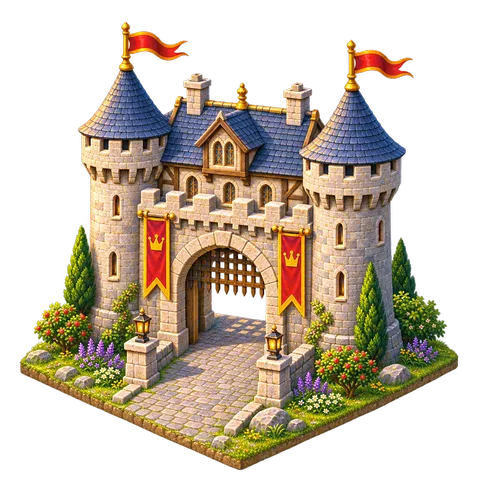
This castle is a storybook version with blue cone roofs and red and gold flags. Real castles had cone roofs on some towers, but most were plainer and built for war.
Look closer
- Find the portcullis, the iron-tipped gate behind the drawbridge.
- Count the round towers.
Think about it
- Why would a lord want his home to be a fortress?
- Why is the gate the weakest part of a castle?
- Is there a building in your town that people go to for safety?
Key words
- Keep
- The strongest tower in a castle.
- Bailey
- The yard inside a castle's walls.
- Battlements
- The notched top of a wall that protected defenders.
Use it in class
- How did medieval castles work? (Explainer, grades 3-8)
Sources
The history on this page is a short summary based on these sources:
- Encyclopaedia Britannica, "Castle" and "Motte-and-bailey"
- UNESCO World Heritage Centre, "Castles and Town Walls of King Edward in Gwynedd"
- UNESCO World Heritage Centre, "Historic Fortified City of Carcassonne"