
From earth mounds to stone walls
The first castles were quick to build. After the Normans conquered England in 1066, they put up hundreds of motte-and-bailey castles: a wooden tower on a tall earth mound (the motte) above a yard closed in by a fence (the bailey). Over the next two centuries, many were rebuilt in stone, which could not be set on fire.
Rings of defense
An attacker had to get through one defense after another.
- A ditch or a moat full of water kept attackers and their ladders away from the walls.
- A high curtain wall ran all the way around, with towers sticking out so defenders could shoot along the wall. Round towers were harder to knock down than square corners.
- Battlements on top had gaps to shoot through and solid parts to hide behind, and narrow slits let archers shoot out while staying safe.
- The gate was the weakest spot, so it became a fortress of its own: a gatehouse with a drawbridge, a heavy grille called a portcullis, and thick wooden doors.
- In the middle stood the keep, the strongest tower, where people could hold out to the end.
Who lived in a castle
A castle was busy. Besides the lord and lady and their children, it could hold a steward who ran the estate, cooks, grooms for the horses, a blacksmith, a priest, guards and many servants. Everyone ate together in the great hall, where the lord also held court and settled arguments.
A castle needed its own water, so most had a well inside the walls, as well as storerooms, a kitchen and a chapel.
Why castles stopped being built
By the 1500s, gunpowder cannons could break even thick stone walls. Strong kings also did not want lords to have private fortresses. Builders made low, thick forts for guns instead, and rich families moved into comfortable houses with big windows.
Try it in class
- Draw a castle plan from above, with every ring of defense labeled.
- Build a cardboard gatehouse with a portcullis that goes up and down on a string.
- Find the defenses in the pictures of the Royal castle, Gatehouse and Watchtower pages.
- Look at the treadwheel crane, then work out how builders lifted stone without engines.
Questions for students
- Why would a lord want his home to be a fortress?
- Why was the gate the weakest part of a castle, and how did builders fix that?
- Is there a building in your town that people go to for safety? How is it like a castle?
Questions students and teachers ask
What was the strongest part of a castle?
The keep, a great tower in the middle. If attackers got past the walls, defenders could hold out there.
Why did castles have moats?
A ditch or moat kept attackers, ladders and siege machines away from the walls, and made it hard to dig tunnels under them.
How long did it take to build a castle?
A wooden motte-and-bailey castle could go up in weeks. A big stone castle took years: work on Caernarfon Castle in Wales began in 1283 and went on for about 50 years, and it was never fully finished.
Building pages to use with this guide
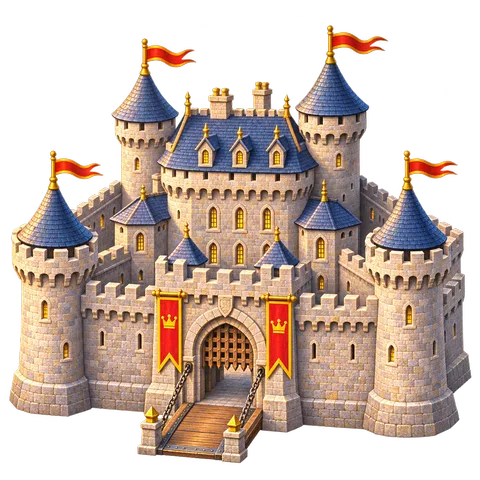 Medieval KingdomRoyal castleA fortified home for a king or lord: thick stone walls, towers and a gate that could be shut tight.
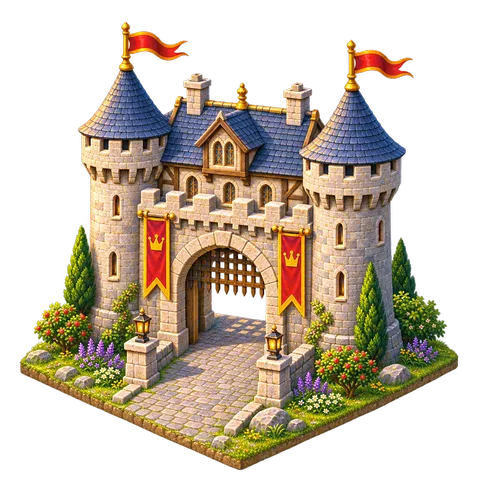 Medieval KingdomGatehouseA fortified gate between two towers, where guards decided who could come in and collected tolls.
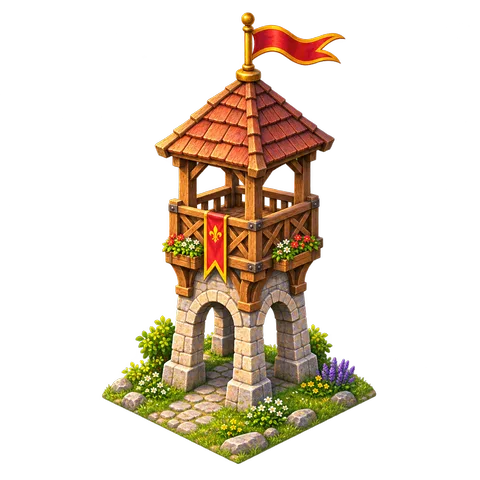 Medieval KingdomWatchtowerA lookout where watchmen kept an eye on the roads and the town, day and night.
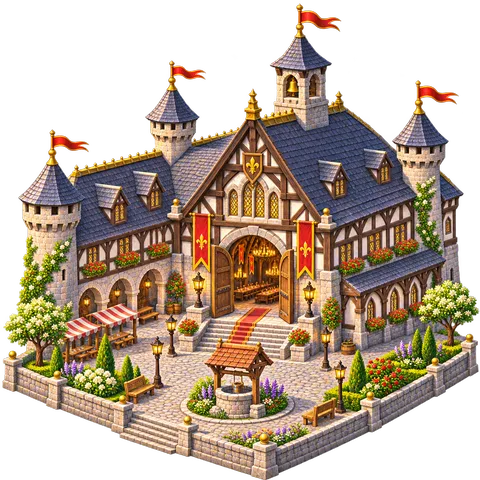 Medieval KingdomGreat hallThe big room at the heart of a castle or manor, where the household ate, met and held court.
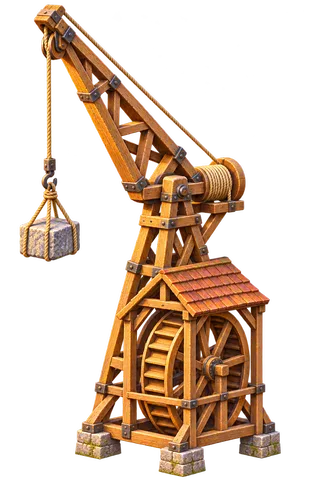 Medieval KingdomTreadwheel craneA wooden crane powered by people walking inside a giant wheel, used to lift stone for castles and cathedrals.
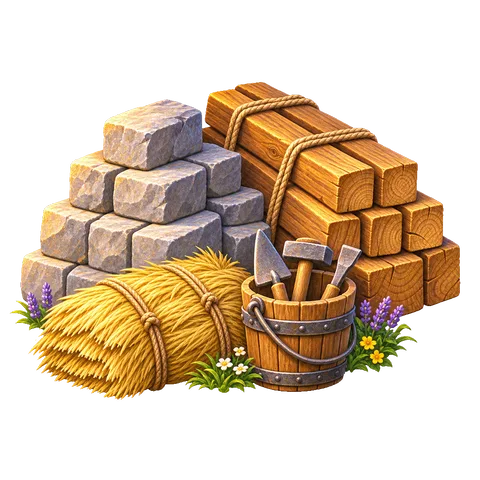 Medieval KingdomBuilding materialsCut stone, oak beams and bundles of thatch: the materials that built castles, churches and homes.
Sources
The facts in this guide are based on these sources:
- Encyclopaedia Britannica, "Castle" and "Motte-and-bailey"
- UNESCO World Heritage Centre, "Castles and Town Walls of King Edward in Gwynedd"
- National Trust, "History of Bodiam Castle"