History How it worked
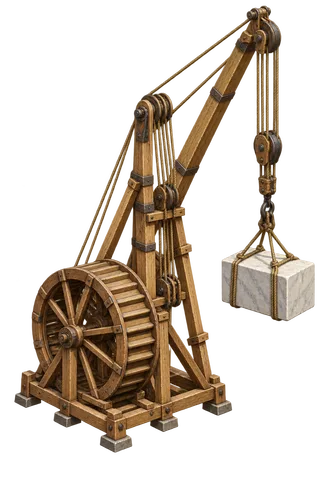
Medieval builders lifted heavy stones with treadwheel cranes. One or two workers walked inside a big wooden wheel, like a giant hamster wheel. As the wheel turned, it wound a rope around its axle, and the rope ran up over the jib to lift the load.
Because the wheel was much wider than the axle, the walkers could lift far more than they could carry. The idea goes back to the Romans.
History Cranes that survive
Some treadwheels still sit inside the roofs and towers of English cathedrals, where they were used for building and repairs. In Gdańsk, Poland, the Crane (Żuraw), built in the 1400s, is a huge wooden harbor crane between two brick towers. Its treadwheels lifted cargo from ships and set up the masts of new ones.
Art In this artwork
This crane is drawn with its wooden wheel at the bottom and a long jib lifting a stone block.
Look closer
- Find the big wheel. Where would the walkers be?
- Follow the rope from the wheel to the stone.
Think about it
- Why does a big wheel make lifting easier?
- What machines lift heavy things on building sites today?
- How would it feel to walk in the wheel all day?
Key words
- Treadwheel
- A wheel turned by people walking inside it.
- Jib
- The arm of a crane.
- Axle
- The rod at the center of a wheel.
Use it in class
- How did medieval castles work? (Explainer, grades 3-8)
Sources
The history on this page is a short summary based on these sources:
- Encyclopaedia Britannica, "Crane" (machine)
- National Maritime Museum in Gdańsk, "The Crane" (Żuraw), built in the 15th century