History Stone and mortar
Castles, churches and bridges were built of stone, cut from quarries and shaped by skilled masons. They set the blocks in mortar made from lime, sand and water, which slowly hardened. Many masons cut a small personal mark into the stones they shaped, and these marks can still be found on old buildings.
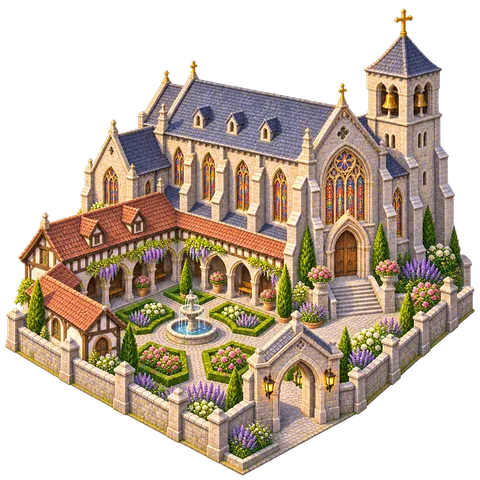
Great churches took a very long time. Cologne Cathedral in Germany was begun in 1248, stopped for centuries, and was only finished in 1880, following the original plans.
History Timber and roofs
Oak was the main building timber in much of northern Europe: strong, long-lasting and good for frames and roof beams. Ordinary houses were roofed with thatch, while better buildings used clay tiles, stone slates or, on churches, sheets of lead.
Art In this artwork
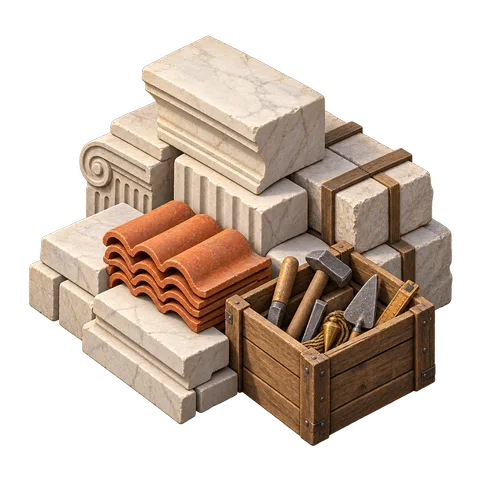
The stacked stone blocks, beams, thatch bundle and bucket of tools are the artist's picture of a medieval building site.
Look closer
- Find the bundle of thatch.
- Which tools can you see in the bucket?
Think about it
- Which materials could be found close to a village, and which had to come from far away?
- Why would a cathedral take so long to build?
- What is your home made of?
Key words
- Mason
- A worker who cuts and builds with stone.
- Mortar
- A paste that sets hard and joins stones or bricks.
- Quarry
- A place where stone is cut from the ground.
Use it in class
- How did medieval castles work? (Explainer, grades 3-8)
Sources
The history on this page is a short summary based on these sources:
- Encyclopaedia Britannica, "Masonry" and "Mortar"
- UNESCO World Heritage Centre, "Cologne Cathedral"
- Encyclopaedia Britannica, "Half-timbering", "Wattle and daub" and "Thatching"