History What it was
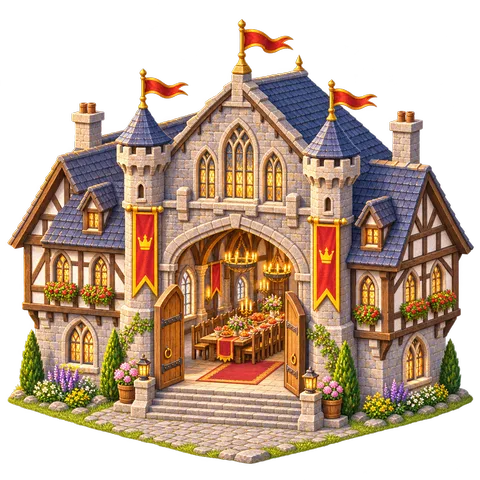
For much of the Middle Ages, the hall was the most important room in any big house. The lord, his family, guests, servants and soldiers ate there together. At one end stood a raised platform, the dais, with the lord's table. Some of the household slept on benches in the hall at night.
The hall was also where the lord did business: listening to complaints, settling quarrels and holding the manor court.
History How it was built
A wide hall needed a strong roof. Early halls had a fire in the middle of the floor and a vent in the roof to let the smoke out. Later, fireplaces with chimneys in the walls became common.
Westminster Hall in London was built in 1097 for King William II. In the 1390s, King Richard II gave it a new hammer-beam roof, one of the largest medieval timber roofs in northern Europe. For centuries England's main law courts met in the hall, and it still stands beside the Houses of Parliament.
Art In this artwork
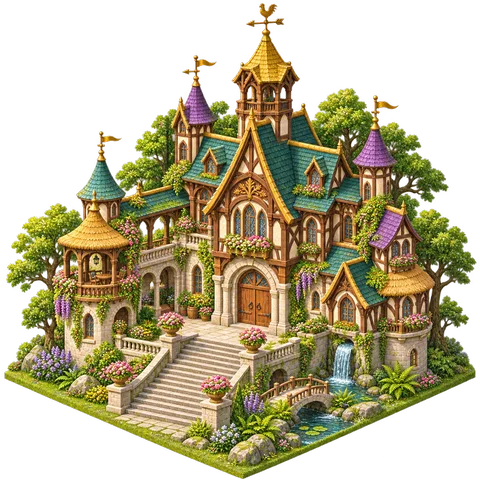
The banners and courtyard well are the artist's design. Real halls were often part of a larger castle or manor house.
Look closer
- Find the big doors. Why would a hall need such wide doors?
- Look for the banners.
Think about it
- Why might everyone in a household eat together in one room?
- Where are disagreements settled in your town today?
- How did people heat a big room before chimneys?
Key words
- Dais
- A raised platform at one end of a hall.
- Hammer-beam roof
- A wooden roof that uses short beams to span a wide space.
- Manor court
- A meeting where a lord or his steward settled local matters.
Use it in class
- How did medieval castles work? (Explainer, grades 3-8)
Sources
The history on this page is a short summary based on these sources:
- Encyclopaedia Britannica, "Hall" and "Hammer-beam roof"
- UK Parliament, "Westminster Hall"
- Encyclopaedia Britannica, "Manorialism" and "Serfdom"