History Who went to school
Most medieval children never went to school. They learned at home, in the fields or as apprentices. But churches, abbeys and towns did run schools, and their number grew through the Middle Ages.
Grammar schools taught Latin, the language of the church, the law and books all across Europe. Song schools taught boys to sing in church. Some girls learned to read at home or in convents.
History A school day
Pupils learned by repeating and remembering. Books were rare and costly, so the teacher often read aloud while pupils copied onto wax tablets with a pointed stick. Lessons could start at dawn and run most of the day.
Winchester College in England was founded in 1382 by William of Wykeham, a bishop, to give 70 poor scholars a free education. It is still a school today.
Art In this artwork
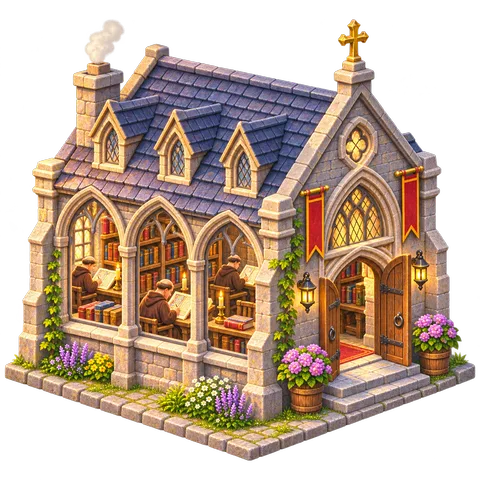
This small timber schoolhouse with benches and a slate board is the artist's own design.
Look closer
- Find the board by the door.
- Where are the benches?
Think about it
- Why might Latin have been so important to learn?
- How is your school day different from a medieval one?
- What would you lose if you could not read?
Key words
- Grammar school
- A school that taught Latin grammar.
- Wax tablet
- A wooden board covered with wax to write on and rub out.
- Scholar
- A student.
Use it in class
- What was daily life like in the Middle Ages? (Explainer, grades 3-8)
Sources
The history on this page is a short summary based on these sources:
- Winchester College, history of the school (founded 1382)
- Encyclopaedia Britannica, "University"